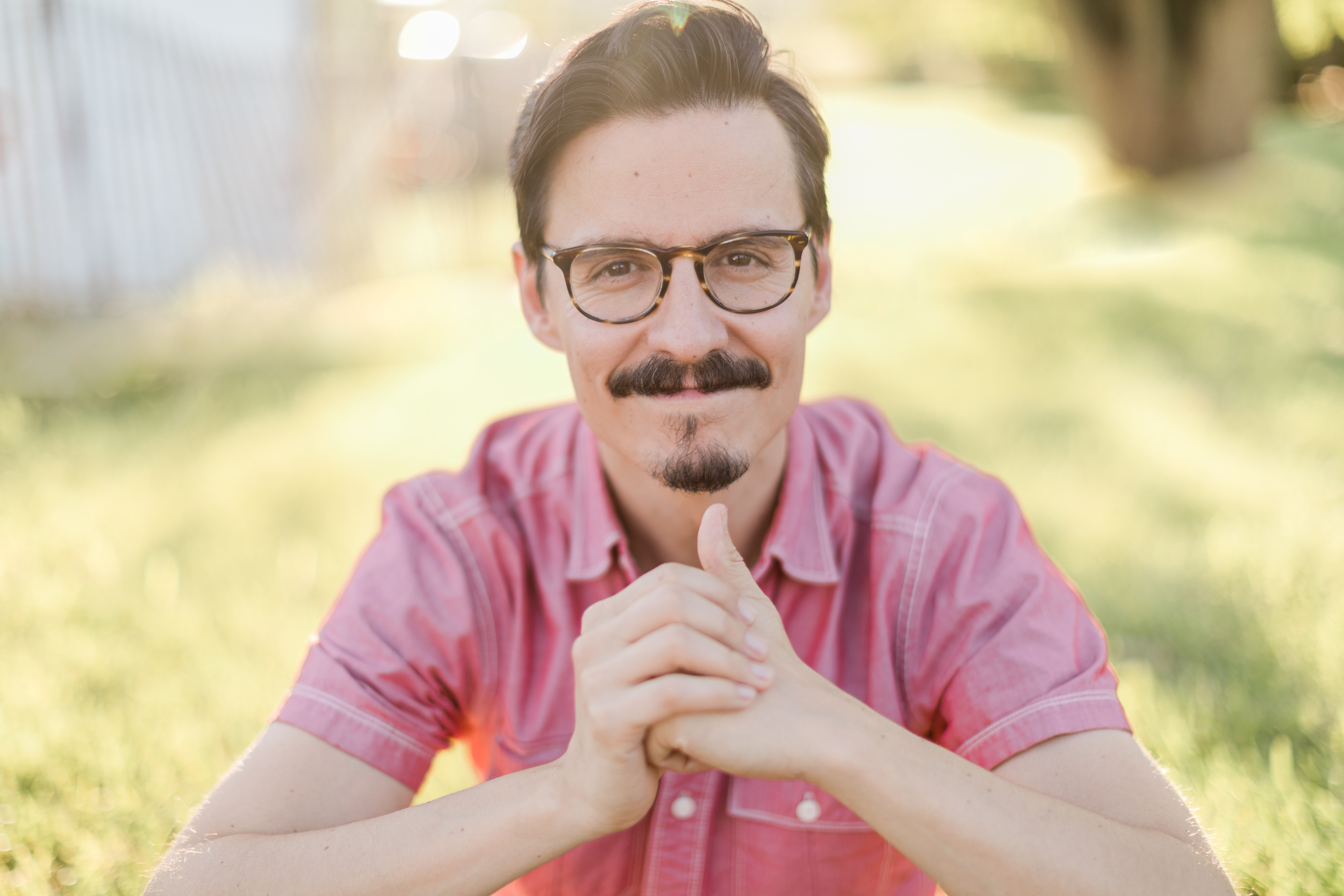
A safe space for narrative-based creative self-expression. From a state of inspiration, found after exploratory somatic sessions and creative movement exercises, theatre games and improvisation techniques, I invite you to tap into your own unique perspectives and “creative flow.” Each class will culminate with writing prompts exploring poetry, prose, or letter writing. Michael’s classes foster a safe and creative environment for all participants, no matter their skill level, because they are rooted in a sense of play and exploration.
Maybe it’s because I lost my own mother to cancer. Maybe it’s because a few days ago I celebrated her 81’st birthday in my mind and with only a couple of texts. Maybe because it’s Mother’s Day Weekend and Spring, and the rain that comes every so often is much needed but often saddening. Like, I’m unable to see the flowers on the other side of the soaking, saddening. Maybe it’s because I’m a father now, new to this adventure, to a baby just out of the newborn phase, that I feel a longing to fill his cup every moment, live my own life with him fully, but with the ever-repeating onus of John Mayer’s never-ending chorus, “am I living it right?”
Maybe it’s because I have lived and breathed words written by the author before, some 5 years ago in a theatrical production of one of my favorite novels. (I played Levin in Gwen’s adaption of Anna Karenina!) Maybe the letters, prose, and poeticism within the larger format of a memoir make this book so genuinely enthralling, so episodically endearing, so wise yet nonchalant, and ultimately, so full of joy! Like having a friend over for tea, because you don’t need any pretense or panache, for your raw, unfiltered conversations. You can simply fall into your natural rhythm of brutal honesty and succinct cutting-cleverness – a friendly pastiche of passion yet predictability – with natural ups and downs, and a shorthanded humor of unsolicited but always welcome downright reality and truth.
This book is hard at times. It talks about hard things, but it’s also hard to put down. There’s a gentleness to it too though, along with a shameless honesty that keeps you there, aware of your openness and willingness to settle in, that allows you to enjoy the ride.
There’s something to be said for memories. Nostalgia. Looking back. Memoirs. Hindsight. Like a documentarian from a distance. Distilling time and space to droplets of clarity, even the ambiguous or hurtful moments. Pinning it down and allowing the world to see and share in that specificity. There’s a strength in vulnerability and there’s always a truth to be shared. That we all share.
Maybe because someplace in my dad’s garage (and I’m sure attic if he had one) there’s a box of my old drawings and paintings and childish crafts, that now that I have my own child I will long to hold onto, and put his alongside mine. But I also long to clear out the old and cherish the new. How does one give your child everything or anything all at once? How do you guide them, support them, love them, let them…? How do you share with them the best version of yourself, your devotion and love, your life? How does one provide for them an image and experience from which to start their own lives? To start without sights on the end? And what if, God-forbid, that end is in sight? What then? What if you are staring down at the shorter end of what is to come, from what has already been.
What would you do?
This book, this story, is really two memoirs. It is the child grown into a woman; it is the mother loving her children through a life she never was able to witness. Somehow love triumphs over death, and a mother carries her little ones through moments in the future within a box of gifts. Gifts to be unwrapped at life’s moments she most wanted to share. And although lost in time are those everyday moments so small yet so magical; there is a desire and a love that carries her presence through and through and through.
I would read bits of this book over the nights when I would stay up a little while after mama and baby went to bed, and I would welcome being transported. To the little neighborhood drawn so lovingly – can you imagine the street where you lived? The backyard or park in which you played? The games or parties you may have had? Your school? Your dances? The porches and painted walls, pets, and people throughout your youth. Forgotten? I think not. For it is through the imagining of my own son’s future that I look back upon my past. I can’t help but at least glance upon that inward eye of memories gone by, as I strive to see this little baby all grown up.
I’m lucky to be able to look back with warm fondness on the days of my youth, though not without some pain. But simply the act of looking back. Reflecting. It’s a gift. Imagine your surroundings – the sights and smells of those parties, the cooking, the conversations, way back when before you mattered so much, or at least before much of life seemed so difficult. This child, this book, this author takes us on a journey throughout her mother’s illness with a sharp discernment, cutting to the core of a memory, with a keen yet kind energy. Ms. Kingston allows her reader to be right there next to her, bedside or on the floor, or grass or playground, or cemetery. With the blinking television or rustling leaves. These are worlds so purely painted, you can’t help but walk beside her and be her friend.
And yet, like most of life, you, as the reader, must allow the inevitable to happen. Watch, along with this little child, as she endures perhaps the hardest thing a child could – the death of her mother. The sickness, the waiting, the moments of curiosity and caring along the way. And then the community she eventually finds as she pieces together the woman her mother was long before the writer was a glimmer in her mother’s eye (as my father used to say!). The strong and bold, beautiful and diligent person before marriage or motherhood… and if you, MY dear reader, have a little one at home as well, then surely your thoughts are equal to mine just now – what am I showing my child of who I am or who I was? What am I showing him as an example of love, as an example of being a parent, a husband, a brother, a son? What was I before and what do I take with me in these new roles as husband and father? What do I give in grace and graciousness? What do I wish for us as a family? What do I wish for you, my dear little one, in the kin we share and community I’ve made for you, and ultimately, the life you’ll create for yourself?
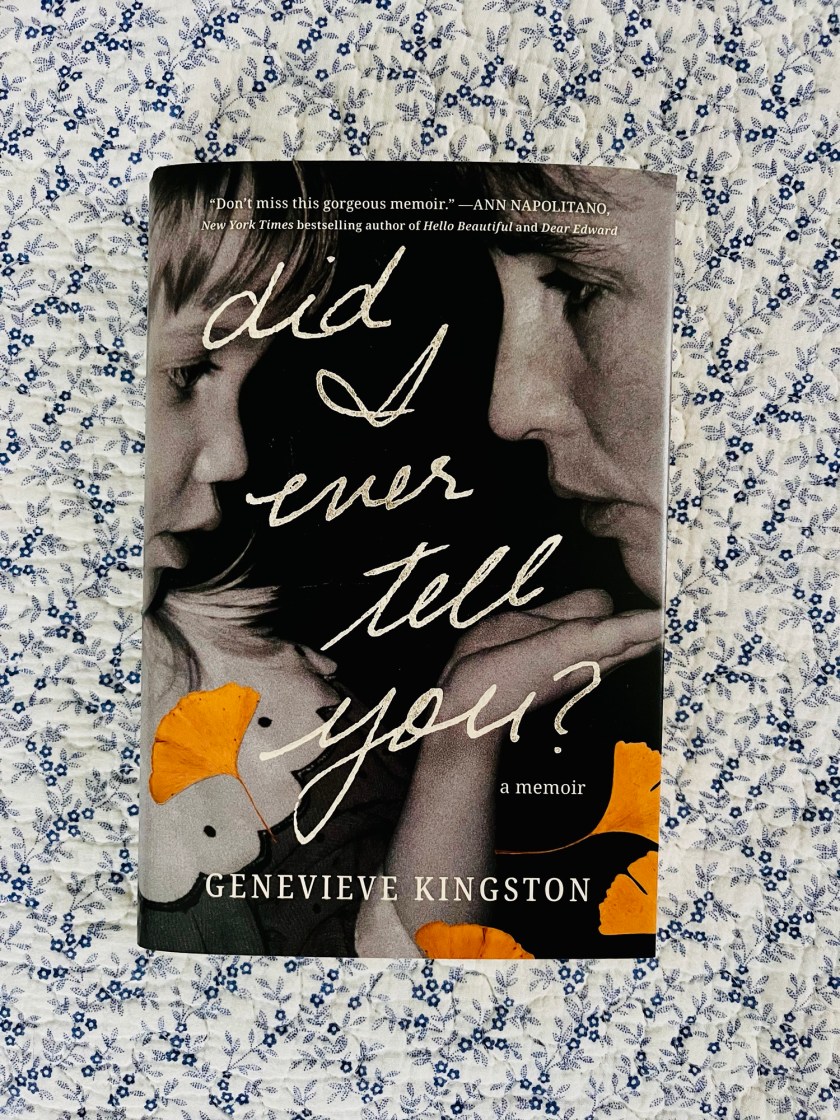
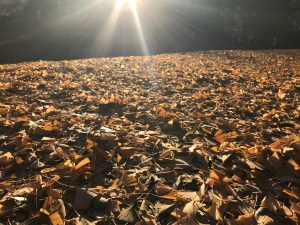
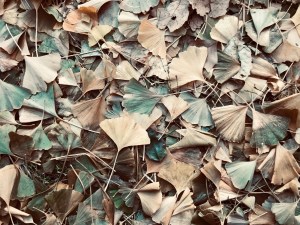
I finished this book a few nights ago and it has remained in my mind, turning over and showing itself from time to time, much like the glimmering gingko leaf on the front cover from a tree in Autumn’s grasp, catching light and wind, shimmering until the end. The book sits on my coffee table and today my son, on my lap, latched on with his eyes, and I brought it closer, he was enamored perhaps by those same golden gingko leaves and striking black and white image and words, did I ever tell you? We played like that for a while, looking on at the photograph of the tender moment a little girl lifts her mother’s chin gently towards hers, then I opened it up to a passage and read it aloud – a letter from the writer’s mother –
I want so fervently and with all of my being to be with you for all of the important, and unimportant things. I want to be here with you to love and protect you, shield you and encourage you, help you see and know all that is best in you, and help you work on the stuff that gets in the way of your happiness…
At 15 weeks it seems a far cry from “Peek a Boo Forest” but nevertheless I pressed on for a bit, before finally flipping back to the gingkoes. Afterwards I reached for a book about a hungry caterpillar and we devoured it.
There’s so much life to live – in each moment we are given. For none of us know the day nor the hour that such moments may never come.
Am I to be saddened at that fact? Hopefully not. For to live in fear of what might be, just might make you unable to live in what is. And the gifts we can bring into the everyday are truly what can feed and sustain and nourish those around us. May I always remember these things. The gifts my own mother gave to me (my father too, and siblings yes!) just by living their life with mine. Fully and free of fear. Or at least, fully, and full of love.
My heart now remembers the mirror images in my mind from Ms. Kingston’s depiction of the cemetery where her mother was buried, and the cemetery where my own mother was buried too. I recall the towering oak tree split in two and low concrete wall on which she sat with her grandfather, mirroring the huge tree and concrete bench by my own mother’s grave, on which I would sit with my dad, my baby’s grandfather. There are other moments too, split like that giant oak, many years ago — for it was often the case, in the dark of night, that childish games or tree-lined streets, backyard parties and college dreams, all mushed together when I lay in bed and allowed the story to rest with me.
And on the eve of such an auspicious occasion – the first Mother’s Day weekend I celebrate my own wife now turned mother. A blessed and grateful party of three! I have to say that I am so grateful for this book, being, as one of my favorite writer’s Sarah Ruhl puts it, “…a beautiful gift from a mother to a daughter, and from a daughter to her readers.”
Commedia dell’arte is what this world needs more of right now.
Photo provided by: Associate Producer Christopher Tramantana, 2023
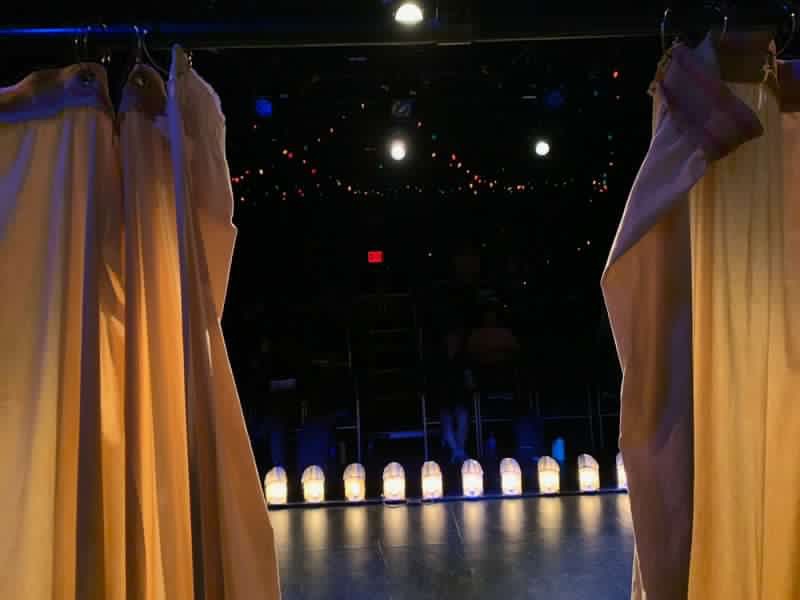
From the first quiet moments and timid entrances, to the grandiosity harnessed by the cadre of characters, the revelatory solo and ensemble work made for a uniquely moving experience. Tucked away upstairs in a black box theatre, hosted by New York Theatre Workshop, there was a sense of playfulness and vitality in the space and effervescence as well as ephemerality that shone brightly by the company of actors.
The music composed by Michael Joseph McQuilken was striking at the onset, and continued to be huge anchor points throughout the night. The company’s attention to detail, as well as daring for invention, carved catchy melodicism into a angsty anthems. Where rawness and snarling made way for sweet falsettos and simple tender poeticism, the cry of laughter heard in the house could quickly turn to a hushed, wide-eyed softness. Where passionate poignancy could erupt through punching and thrashing, sighs of exasperation could equally stun the space into quiet, collective breath-holding.
The emotional inertia of the show is something so palpable throughout the night, wonderfully conceived and directed by Christopher Bayes, and written by Bayes and the Company, it seemed constructed to carry us along yet catch us by surprise — designed for fearless fun, and ferocity alike.
There are sincere and sweet moments nestled neatly inside monologues, so simple they slide right into your psyche with surgical precision; and also soliloquies, audacious and apoplectic in delivery. Plucked from fire, both, the first like a star at twilight, twinkling with searing succinctness; the other, like seething magma bubbling all around us, a volcanic triumph. Jostling their way into our hearts with brilliant juxtaposition, these glimpses of unfiltered earnestness are most welcome in this format.
These are things that are so freeing about commedia dell’arte and what can make seeing it live so exciting.
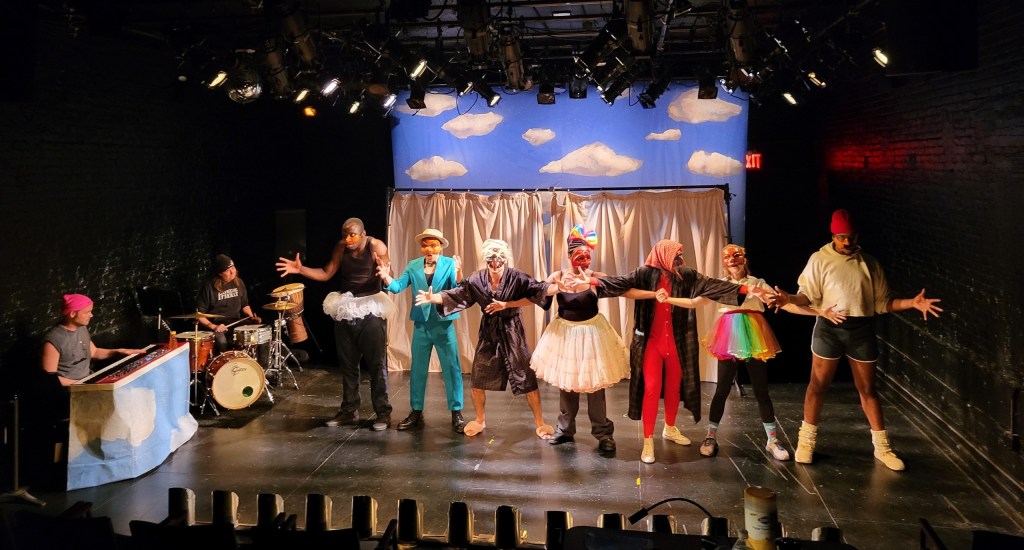
Photo by: Assistant Director Layna Fisher, 2023. the Company: Nomè SiDone, Abigail Onwunali, Sam DeMuria, Maggie McCaffery, Tavia Hunt, yao, Anthony Grace and Shimali De Silva & Musicians: Tommy Russell & Nathan Repasz
After all, there is an altogether invigorating aspect to work like this, but it’s not for the faint of heart, rather for the brave and bold. Where booming sometimes brash and scathing critiques of the here and now, and what we’ve gone through, can reverberate and resound deeply in sometimes new and challenging ways.
And the willingness to open those portals of understanding and fly through them together, while reflecting or refracting society, is something that can keep commedia dell’arte so dangerously fun and fresh.
“for the honey, you gotta say when” is both a rollicking ruckus as well as a roving band of beautiful beings, that come to life to dazzle and amaze, and go out like a brief candle in the summer wind. One thing is for certain, it is a powerful testament to both devised theatre as well as commedia dell’arte as a viable art form, and, dare I say, a vital need in the American Theatre.
Frances Black presents the David Geffen School of Drama’s production of
Company: Nomè SiDone, Abigail Onwunali, Sam DeMuria, Maggie McCaffery, Tavia Hunt, yao, Anthony Grace and Shimali De Silva
Musicians Tommy Russell & Nathan Repasz Assitant Director Layna Fisher Stage Manager Josie Cooper Lighting Designer Kyle Stamm General Manager Natalie King Associate Producer Christopher Tramantana Production Intern E Bayes
One dozen artists making visible the invisible. Making emotionally palpable the reverberations we all have felt. Bringing to life the lives that have left an imprint and examining what the author Svetlana Alexievich calls “the missing history — the invisible imprint of our stay on Earth and in time.”
The following is the first of a series, a collection of my notes, for what is to be a three monthlong exhibition and presentation at ArtYard.
Invisible is curated by Jill Kearney.
Inspired by the words that Svetlana Alekseevich wrote within a documentary novel on the aftermath of a nuclear disaster, Chernobyl Prayer, Invisible also concerns itself with “the ‘missing history’, the invisible imprint of our stay on earth and in time.”
Jill Kearney has chosen artists whose work examines “omitted histories, imperceptible forces, and unspoken narratives which render[s] that which is apparent, misleading, or incomplete.” To illuminate such imperceptible forces during these unprecedented times of volatility is both courageous and characteristic of ArtYard’s mission, and a welcome meditation on what connects us all.
There is so much being said within each piece, by each artist, that one could spend many quiet moments, and many introspective visits within Invisible, and still feel there is more to learn, because, the more you take in, the more questions arise. I’ve decided to start on the first floor…
One. Kawita Vatanajyankur.
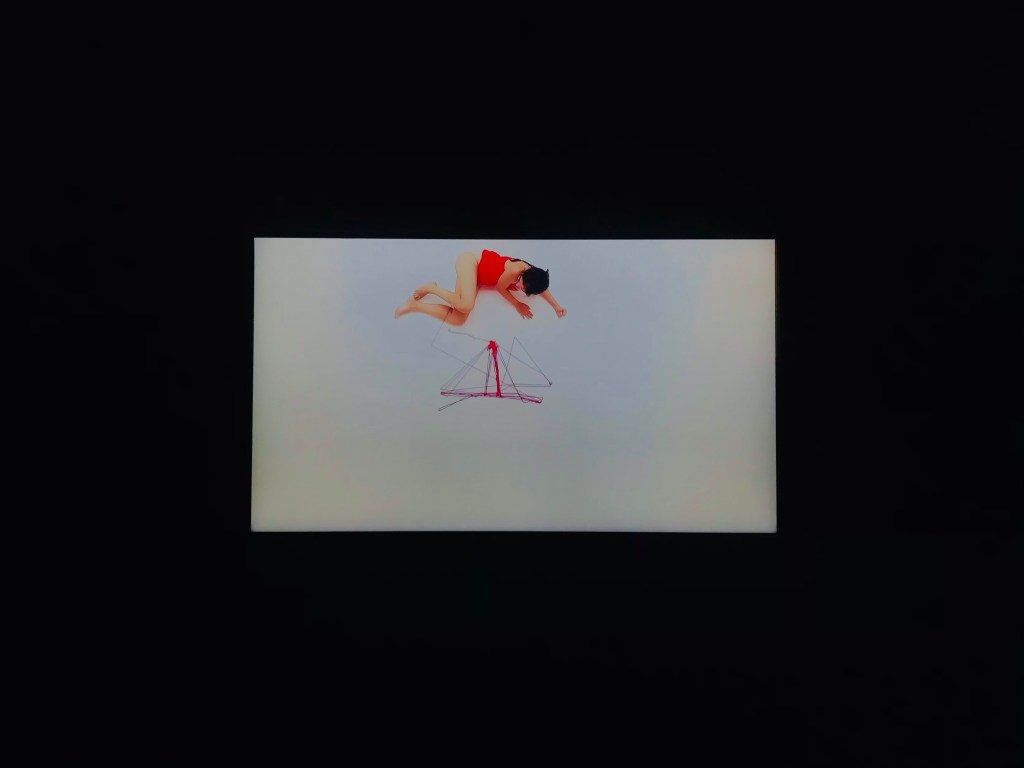
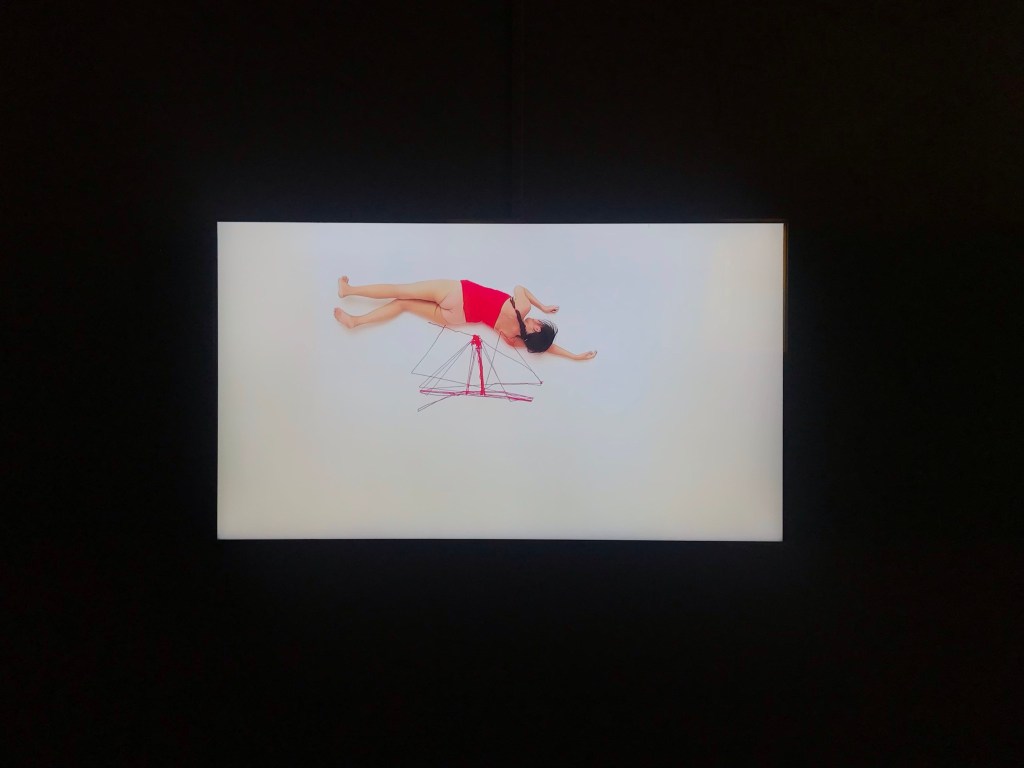
Where pop colors and vibrancy may dissuade the viewer from Kawita Vatanajyankur’s earnestness, spending time to witness her performances for any length of time, earnestness rings true, highlighted by the stark but bold backdrops. There is a voyeuristic awkwardness that may engulf you at first, watching these straightforward, but evocatively performed, tasks by the artist. In fact, the intimate humanity of what has often been called unskilled labor, is put very much to the forefront, and it will humble you.
If you’ve ever caught yourself daydreaming while washing the dishes, you can understand that the repetitive and seemingly futile action of tidying up, can induce the heart’s memory within a sensitive doer. Someone tasked to mop or broom a large office floor, for example, might bring with them their own unique personality and through that repetition be awakened to forgotten memories.
A mother’s mopping might yield a meditation on mourning a lost child, practically taking on the emotional burden of trauma in its physical form, where every step, stroke, and sweep of a mop can feel like trudging through with a veritable ghost on your shoulders.
Vatanajyankur allows time to unfold rather slowly, the process to take on – in painstaking detail – the very effort it demands. Under an emotional microscope, where her entire body acts as both the task and the doer, the performances run the gamut from essentially mundane to sheer necessity. From dying yarn to weaving a loom, washing a floor to gathering packing and weighing produce – work that’s demanded on a constant basis. Dust, dirt, fabric, fruit. Explicitly performed with earnest fervor.
There is a stroke of endurance and performance art in both the making and the viewing, for these recorded and repeating acts take on new life in their detail and recontextualization, separating the human from the work, by ironically bringing the human to the work itself. What really happens behind the scenes? Before a scarf comes to a sales rack? After a long day at the office? Before colorful bounty reaches the table top? Before we consume, who contends with what needs to be created?
Two. Willie Cole’s “Beauties”
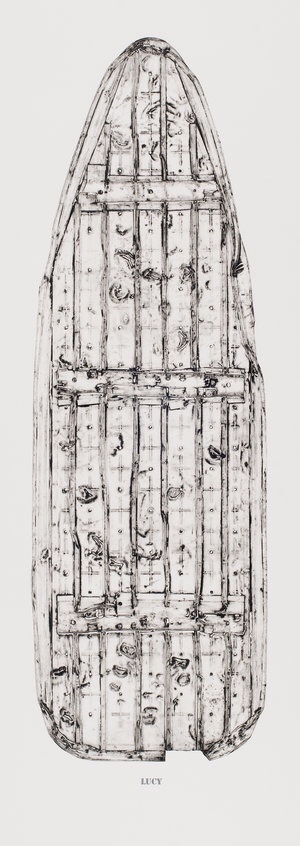
“Lucy” by Willie Cole
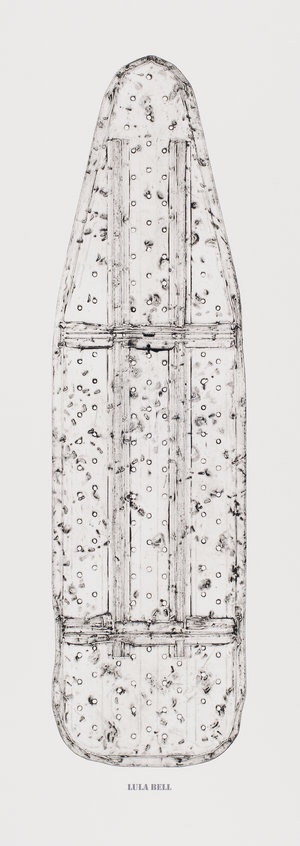
Portraits of five beloved women from Coke’s personal history cast as weathered ironing boards whose shapes evoke iconic maps of slave-ship holds.
~ WillieCole.com
Life-sized, charred, textured. Stamped with burnt edges, embossed Time and time again.
Could you tell who was lefthanded? Could you tell who may have favored a sore back or shoulder?
The curve of a shoulder, a neck and back at work. Lovingly beset to beauty, rendering their memories whole — and part of a greater whole.
Where pressed white-collars-and-sleeves-steamed-and-starched go about the world with impeccability, there lies behind-and-underneath marks of work and will. Marks of time and effort.
Stepping back and seeing the whole picture… These outlines and marks seem like photographic negatives or remnants rich in the bloodstained hulls of Slave Ships, and the thousands of lives lost to a sinful system of systemic stealing and slaughter. The incendiary passage of time and space traversed by the hot irons of colonialism and chains of capitalism, forged link by link, to their cost-effective collateral damage of hypocritical hierarchy. Forever etched into the psyche of a nation, inextricably and indelibly linked.
Life-sized, charred, textured with burnt edges. Stamped, burnt, embossed. Time and time again.
“Lula Bell” by Willie Cole
Three. Sandra Ramos.
Notes on…
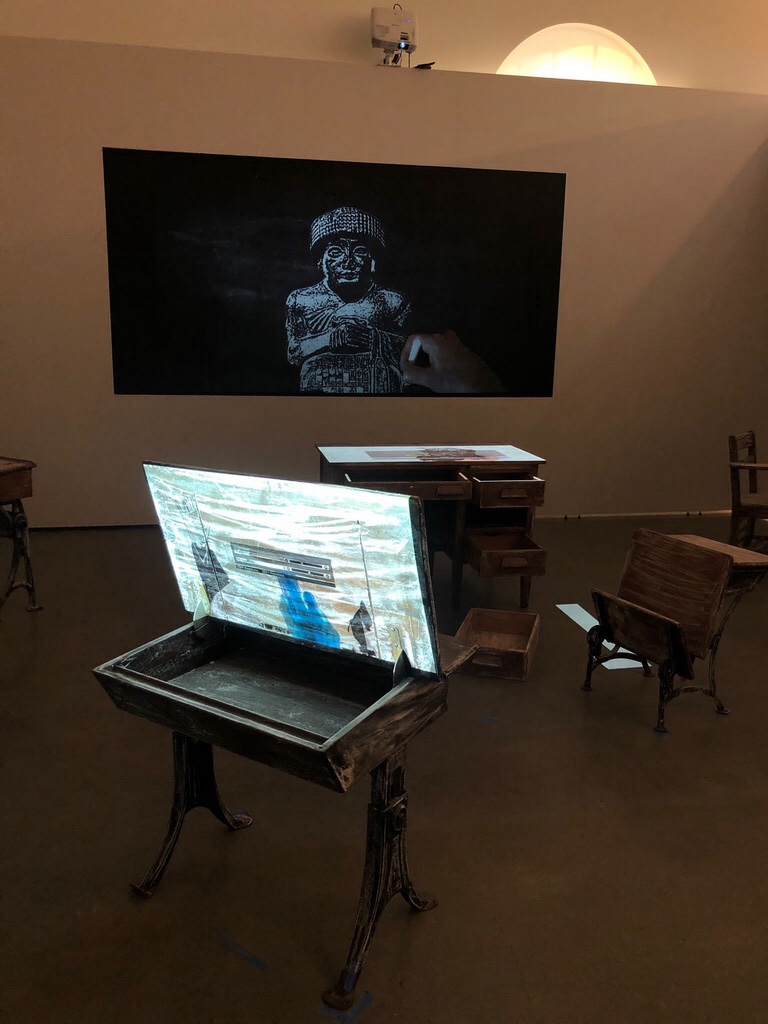
“The Hand of History.” Multimedia Installation. Soundtrack composed by Pavel Urkiza.
Antique desks “painted” in dusty chalk with chairs suspended in the air.
You are immediately transported into the back of a classroom with the inertia from the day still palpable in the air. A surreal semblance of memories and magic.
Rhythmic transference keeps the atmosphere light not wistful, propelling us forward deeper into time into our own imaginations?
What would you write about? Who would you write about? Who makes a difference in your life? Who do you love? Why do you love them?
From the mouths of babes, in their own hands, there are drawings and essays. They have shared their heroes with us and so should you. Chalk and pencil lead. Aged wood and wrought iron.
Something so fleeting and impermanent With prospects to slip away from the present. The permanence and prominence of digital media, there is something indelible, intelligent, and earnest – powerful about each story.
They are here – They are reactions to someone who has made a mark on the future.
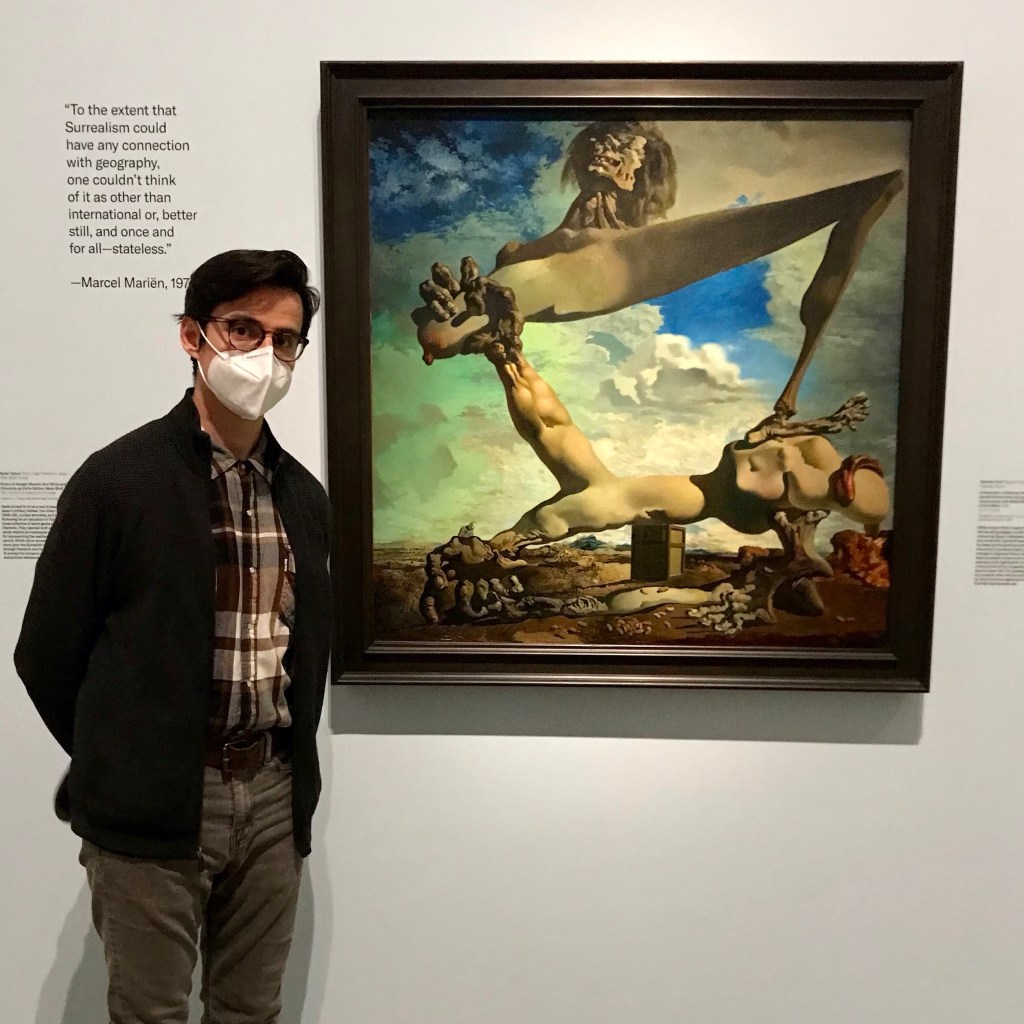
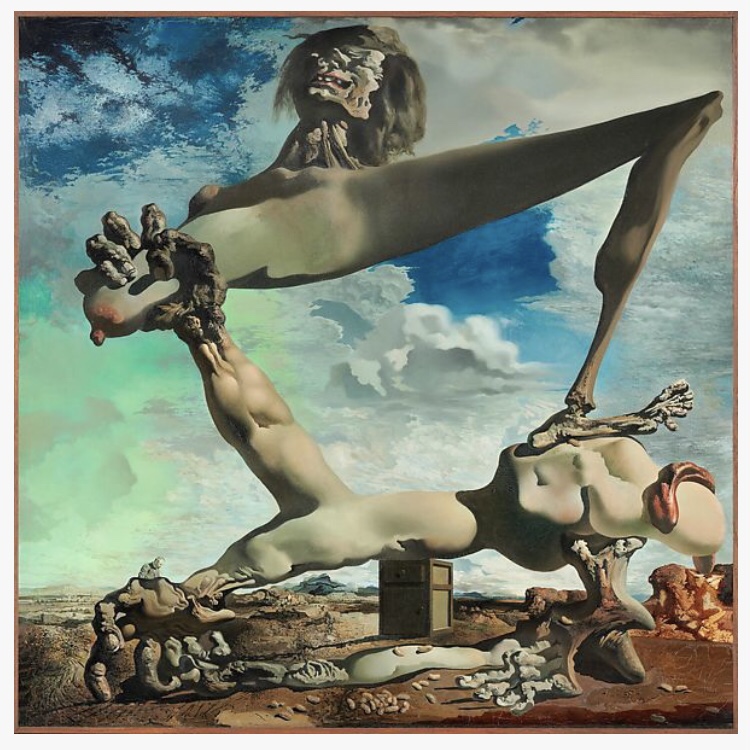
Construction molle avec des haricots bouillis (Premonition de la guerre civile)
(Soft Construction with Boiled Bean [Premonition of Civil War])
1936
When an artist sees the world, is there a certain sensitivity and openness they must possess to be a vehicle of truth and veritable muse all their own? In order to shine that certain light, from their unique vantage, must they first inhabit what they study, with all their attention and imagination as if to focus on their vision aside from all the rest?
Surely an artist should be ‘part and parcel’ of their own making, should ‘write what they know,’ and immerse themselves ‘in the world of the play,’ but what if their world is rife with pain and reeks of injustice. Should they share and shine a light? Splinter or refract, reflect or even revolt, against the truth that they face? Where there is hatred, should they show love? Where there is despair, hope?
To be a true vessel must artists carry the burden until the burden is shared? And after that, is their burden ever fully lifted? For once they have tasted form the tree of knowledge, it’s nearly impossible to let it go.
From a world turned upside down, to see their own few, futile, fleeting, feeble hands and eyes and hearts that seem caught up in the frenzy — of freedom and fancy, of destructive greed and disdain for their fellow peoples.
Are these artists, who cannot abide the world as it is, in their own way, trying to change the world through their art? Do they try to depict the chaos and suffering in the only way they know how? Utilizing quotidian or classical forms stretched and skewed to fit their arguments perhaps? Show me the end of the Realist paradigm in international politics and I’ll show you the rise of Dadaism and Surrealism, and incendiary points of view all their own, that we see all over the world in galleries brave enough to ask more questions then posit mere opinions.
And still they must persist, these first social practice artists, poking and prodding the expectations away from the cozy corner of complacency. Still they must fight against questions like: “What use does the pen have in the face of the sword? What will flecks of oil drying on a staunchly canvas and frilly fabric woven do to preserve the future of democracy?” Or should art be something more fierce and surgical in its delivery? Should it be more daring…? Does it only shine for those who care to see?
Of course art is as unique as the very humans that dare be called by their own imagination’s voice to come and be creative. And as such, luckily there are all kinds of art to be made.
Then what do you make? What are you called to make?
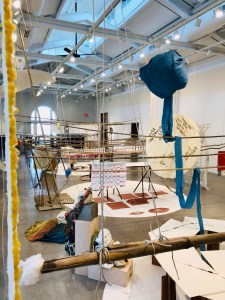
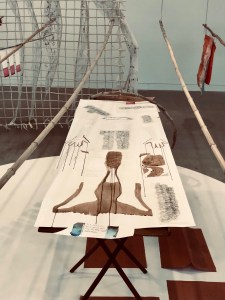
Land locked and forlorn, the ink outlining the Great Lakes form a forgotten memory of “a beginning / end,” a memory or a friend. Like the moving Delaware, just beyond these window panes, this spot may feel familiar, but Her current is always moving and never quite the same.
Within the “source” there’s a “paradigm shift” threaded between a collective and community betwixt consumption and care.
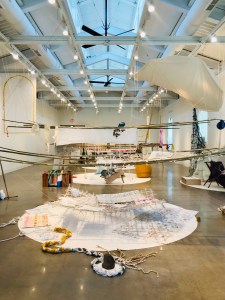
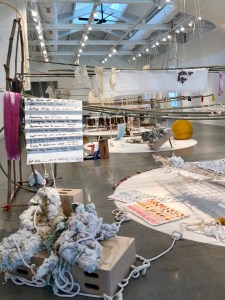
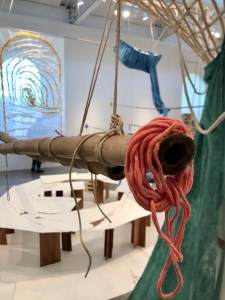
The words speak loudly and concisely as well as consistently, as they seem to echo throughout Earthen materials, formed by human hands. Where bamboo, some still green, form the hull of a ship, lashings and loosely bound yarn and string and metal seem to support the whole of existence. From nature to mater to revolving stone. Forgotten earth and hidden truths, undone and revealing all the same.
Textiles and shed cotton take their place among wax imprints and metal structures, like candled memorials — a living memory, deconstructed.
Braided rope, and knotted line sustain this massive skeleton-like vessel. Like Queen Mab, who plats the manes of horses in the night, only to speak as well as spy, one can feel the power of life itself within wisps of lithesome mischief and merriment despite the evocation of daily toil. It’s only after we step back from the fray, perhaps imagining a grand ship alone on the waters of night… There we can sense (John Donne’s) “Break of Day” when those busied folk are found wanting. Those busy heads, whose love lies heavy in words of redress and regret. Those who only see, but never care to listen.
So, as these artists suggest, we should go on “experimenting with sideways witnessing” so I say, yes, and stay — go deep inside while we’re here. Or there. Wherever that place may be once the direction is clear. Or should we simply “be,” (as of it’s simple at all) amongst the collective memory and rage we all have felt. When the youthful smell of revolution seems to subside as faithfully as those aches take on deeper physical forms — from heartsick pangs to pain meds in hand — where do we stand, and from where do we gather, when we finally choose to be one among a many?
And if we are lucky enough to see our responsibility, do we have the ability to respond to what we collectively care about, that is to say, “care for?” Do we not see? That we whisper the same words of all that have come before, when we truly stop to listen?
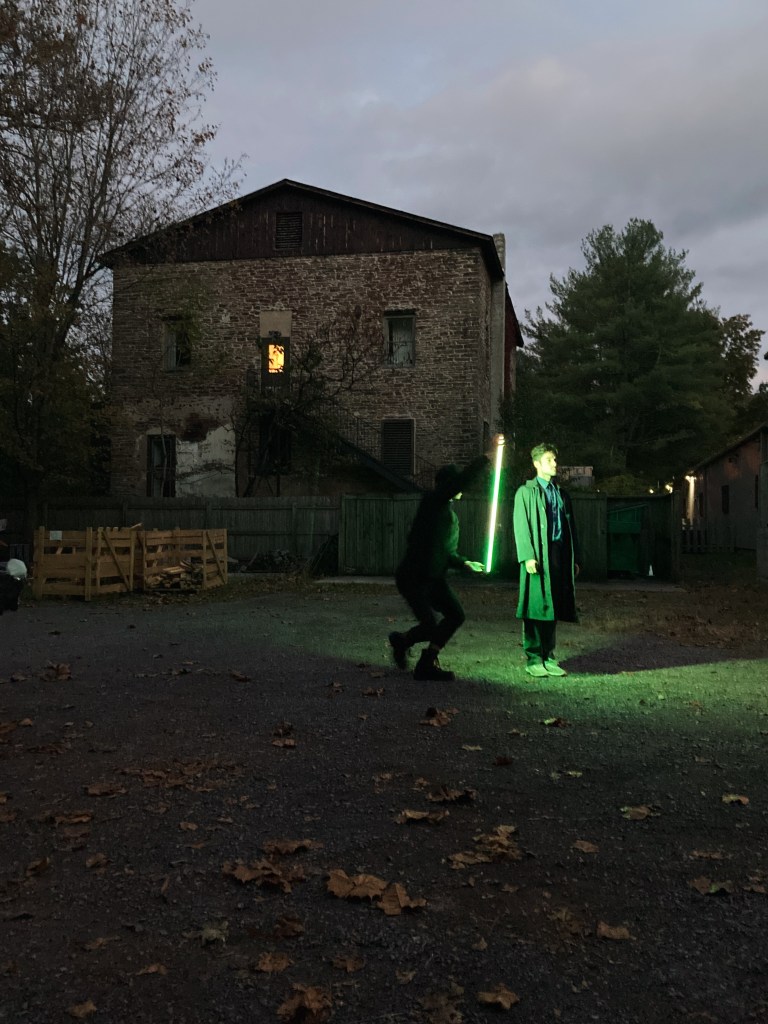
Starting on the lawn in the front “Yard” we go for a walk along the River. Grass to crushed stone. Oak trees and falling light. The Delaware was a quiet, but brilliant stunning sight.
Circulating conveyor belt. People moving through the wreckage. Silently, a body pushes against the orbit which surrounds her. Seemingly unable to stand bound by steel and centripetal force. Inertia of any kind only governs matter, and not the mind and heart. Arching away, fighting, backing up and hearing, “Microphone check. Microphone check…” and the revolution has begun.
Entering the outside again. A new world.
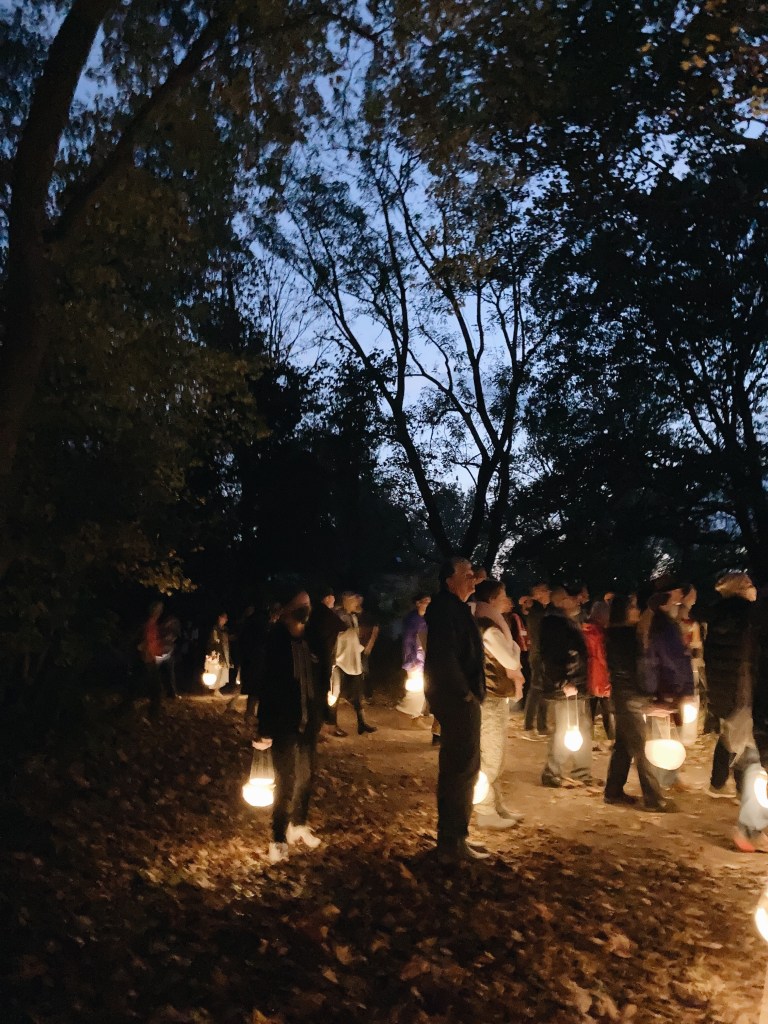
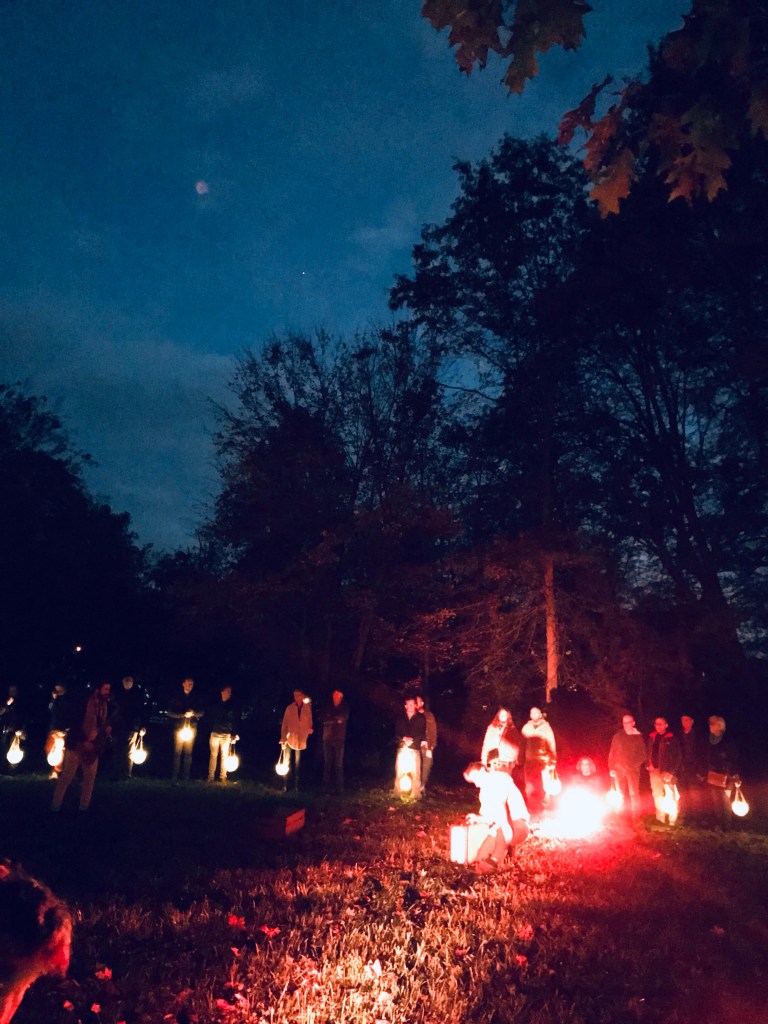
Minor melodies chromatically invite us closer, and we gather ‘round the campfire while the musicians spin their yarn. The music turns to dance, to groove, to night. Finding our way led by another light to dead ends, and surveying watching we wait, and what was once music now seems to take a turn. Gun fire. Mortar shells. Up above, someone yells, “over the wall! This is not a drill!” Sirens. Should we help?
Suddenly there’s a halt. Scanning, body mapping. Taking record. Mounting pressure. Body contact. Breathe.
Walking more and we get to witness the puppet strings. Bureaucratic tangled webs. Latching on. Freedom yet?
Music in the night. Lighting the way. Dancing in the light we carry. Each one of us. Within us too? We hold fast and walk on. And holding on we cross a stream cold and serpentine. Holding on, still, a memory from before? Is she the same or another? Aren’t they all the same? Aren’t we?
Crossfire corkscrews in just the nick of time, not deep enough to kill, is just escaping the push and pull. Tossing and turning there is no end in sight. Climbing, climax, clarity? From above a pedestal rises the heat of another’s words, uttered loud in the night, but for whom doth the voice speak? It tolls for thee. Lay down your luggage here, and take instead my fire.
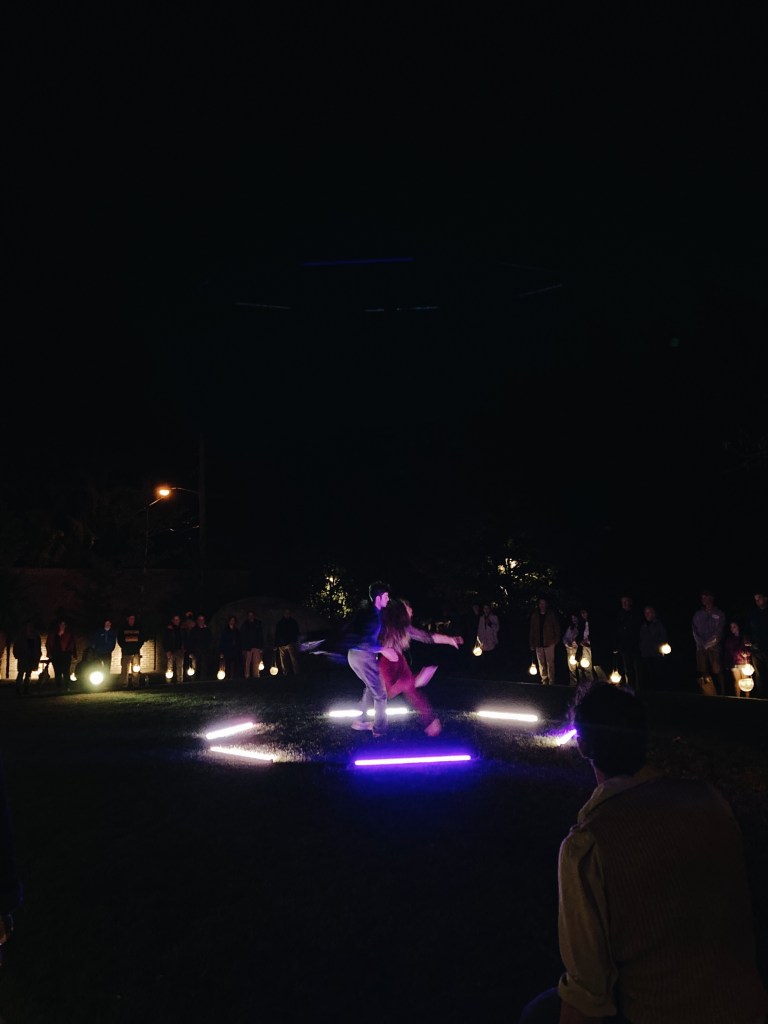
Under the cover of night surrounded by city lights. By people. Encircled, we witness. Traipsing traversing travelers need all. Beaten? Balanced. Breathing heavily. Gasping. Grasping. Glued.
Gleefully we continue. The music takes us now. Through nature once more. We are those that stalk by night.
Sirens, whines. Full circle once more. Within the suitcase a whispered memory. A breath of soul, enshrouded.
Conjuring the snake like sensual memories. Carefully unpacking. Slowly breathing life within these things we carry. Artifacts, stories. Stone.
Trail and tales. Tous ensemble.
Joyful coming to. Bringing forth. And welcoming home. Light up the night, for the light is on inside.
There’s still a flower that tends to whisper A fragrant sweet and soft goodbye, Only for those close enough to give The fathoms deep, rows to reap, Nose of longing citrus fruit, With ties to ancient clay and root…
For those that dare to stop and smell, And close their eyes and dare to tell, “Dear heart come with me, Let me show you how I see, Stand here still, and better yet Plant your feet and take a bow,
Close upon this blossom bounty Bound but once, and now all free. Take it in. Slowly, purely. Take it in. Wholly, only. Take it in. Now, be.”
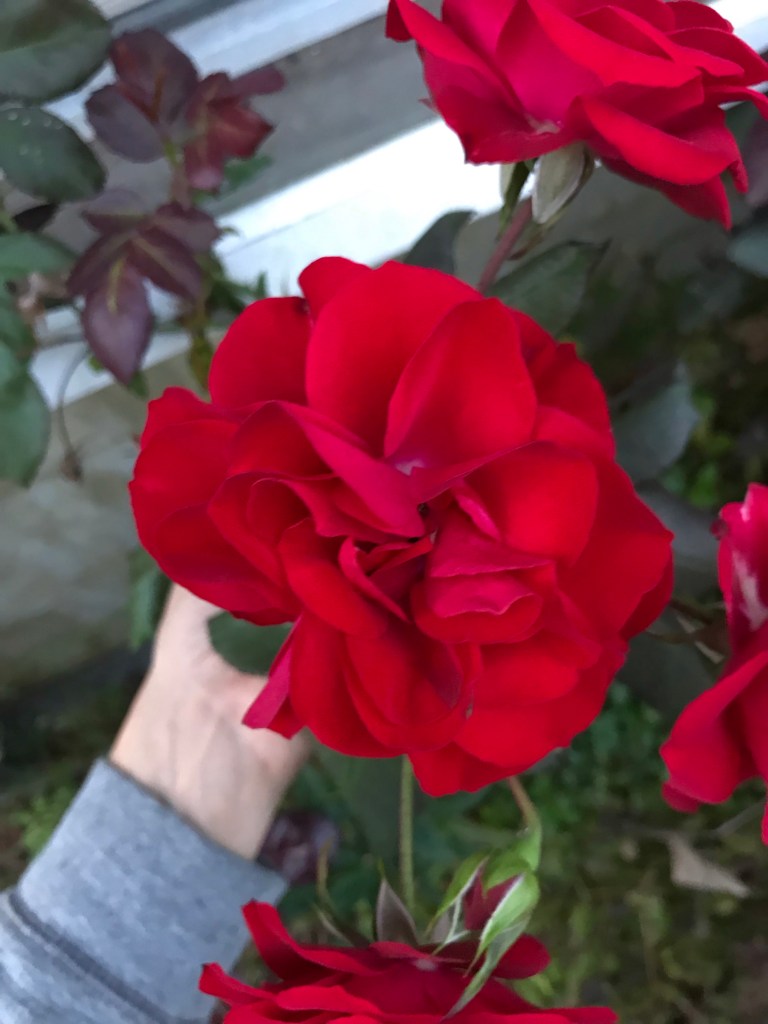
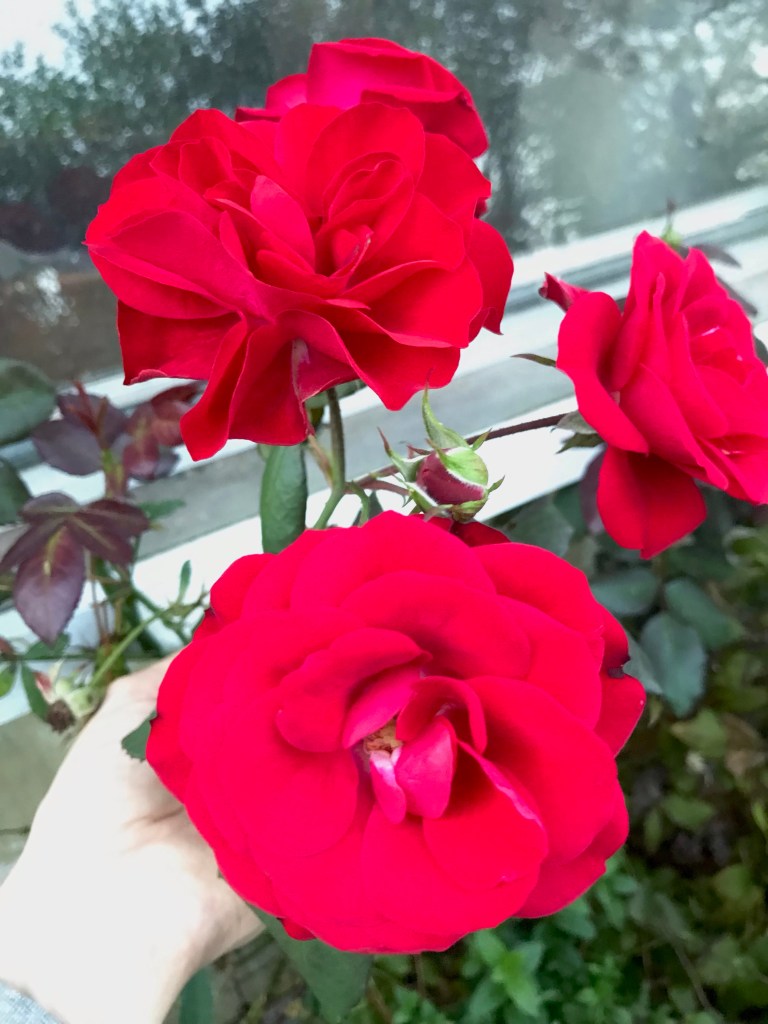
And nothing but faint memories Seem to wash upon the shores of mind: Abuelita tends the roses And fills the water for the birds. Crystal rainbows table tops Crochet patterns rosary beads.
And once again sweetness fills… “Another breath, my dear, please! In so sweet a world, a rhyme, Wash away another time!” Although smiling eyes and laughs do linger, My mortal feet feel the dirt once again.
So I relive the days gone by Basking in my memory. And beneath the dirt where roots grow, Between the throes of sweat and dew, Where winter’s winds begin to blow, The gift becomes an Autumn Rose.
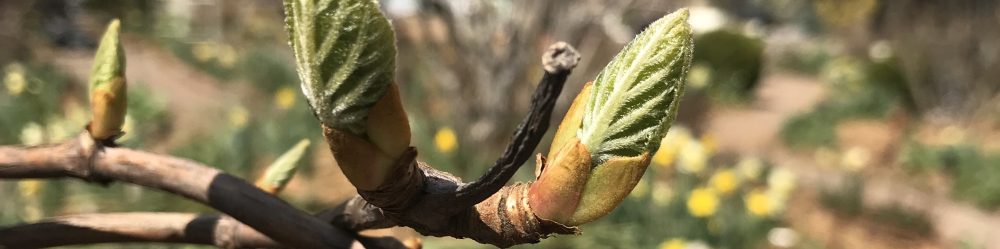
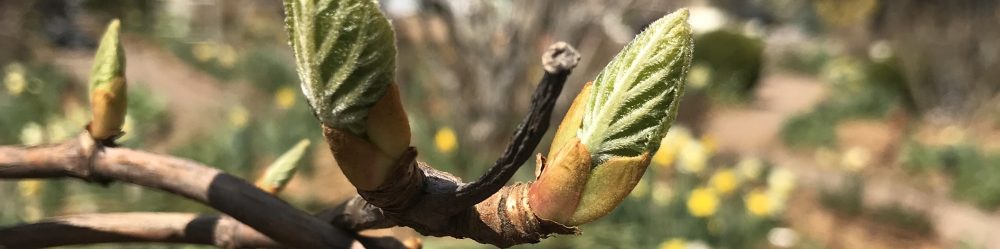
Within the boughs of winter-laden trees, Hardened with kinetic proof against time, From ancient earth to root through trunk to leaves Lies life’s invisible resilient climb.
Bubbles or spears bursting with tender life, Hard-packed or fuzzy-soft in yellow green, Patiently adorn winter’s deadened strife Joining conifers, on gray boughs, serene.
In their due time they fill the forest full Bearing solar brunt, cooling underneath, And teaching us to go from push to pull, Through tempest pain there’s always more than grief.
Through winter storms and all the season’s rest, We must needs give to all our very best.

 Michael Vitaly Sazonov